


Photo source by Alinear Indonesia Docs. (Adobe FireFly – Gemini AI)
Within the financial calculus of the creative sector, a hidden operational cost quietly erodes corporate profitability without ever appearing as an explicit line item on the balance sheet: the Coordination Tax. This tax represents the collective time, energy, and mental focus drained by simply checking if work is getting done. Status-update meetings, endless Slack pinging to trace revision histories, and the manual reshuffling of cards on static Kanban boards are forms of internal bureaucracy that stifle momentum.
As operational margins tighten and asset delivery timelines accelerate, relying on human project managers to manually track every minute detail exposes a critical point of failure. Top-tier digital advertising agencies and video production houses in Jakarta can no longer absorb these structural inefficiencies. The industry demands a radical departure from passive tracking toward an operational framework driven by autonomous computational intelligence [Smart Activation].
AI-Augmented PM: Moving from Static Tracking to Predictive Modeling
AI-Augmented Project Management is not a glorified calendar app wrapped in marketing buzzwords. It is a dynamic data architecture woven directly into the daily workspace of creators—plugging seamlessly into design ecosystems like Figma, code repositories, and high-compute 3D rendering pipelines.
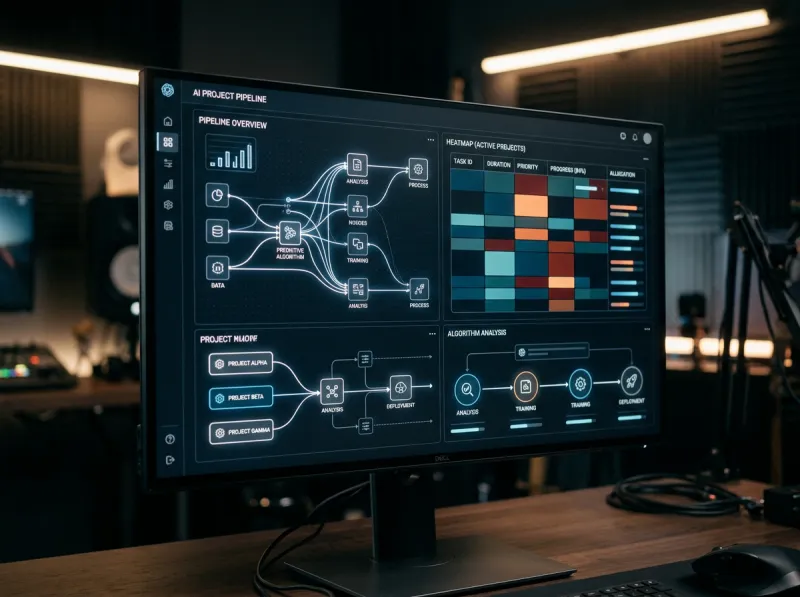
Photo source by Alinear Indonesia Docs. (Adobe FireFly – Gemini AI)
The platform operates by observing the subtle digital telemetry of a team’s daily output without disrupting their creative flow. Predictive algorithms calculate historical asset execution velocities, identify individual productivity rhythms, and measure the historic friction coefficient of specific client relationships.
If the algorithm registers that a senior motion designer is pacing 25% slower on a set of visual assets than historical projects dictate—perhaps due to asset complexity or creative fatigue—the system doesn't wait for a weekly status check. It projects the downstream domino effect on color grading and audio engineering days before a deadline is missed.
Autonomous Resource Allocation: Solving Bottlenecks Before They Manifest
The definitive power of an AI-augmented engine rests in its mandate to execute mitigation strategies autonomously. Once a projected bottleneck is verified, the system runs immediate multi-variable simulations for realigning agency assets.
The engine scans the broader agency ecosystem for a peer with identical technical competencies and open cognitive bandwidth. It then quietly reassigns the high-risk sub-task to the clear pipeline. This entire rebalancing process occurs in the background, neutralizing the need for emergency meetings or panicked email chains. By flattening horizontal communication pathways, it optimizes management hours for higher-value activities.

Photo source by Alinear Indonesia Docs. (Adobe FireFly – Gemini AI)
Killing Micro-Management to Reclaim Deep Creative Work
For creative professionals, the ultimate enemy of breakthrough innovation isn't a restrictive budget; it is the constant fragmentation of focus caused by administrative interruptions. Forcing a creative director or copywriter to surrender two hours of their day to logging timesheets or fielding status inquiries chips away at the cognitive reserves needed for original thought.
"Technology doesn't exist to automate human imagination; it exists to eliminate the internal bureaucracy that prevents that imagination from becoming reality."
By transferring macroeconomic and micro-administrative burdens to predictive algorithms, organizations successfully slice 40% out of their coordination overhead. This reclaimed time funnels back into uninterrupted blocks of deep work. Human project managers move away from tracking task boxes and step up as strategic growth architects, dedicating their time to cultivating client relationships and protecting the creative integrity of the output.
The Math Behind the Automation: The ROI of Operational Agility
For executive leaders and stakeholders across the creative media landscape, adopting an AI-augmented workflow is a financial strategy with highly measurable returns. Shrinking the coordination lifecycle compresses the end-to-end time-to-market for major campaigns. This allows agencies to scale up their total volume of active projects without necessitating a linear, expensive increase in headcount.

Photo source by Alinear Indonesia Docs. (Adobe FireFly – Gemini AI)
The competitive advantage of a modern agency is no longer determined solely by the raw ideas generated on whiteboards, but by the structural cleanliness of its operational delivery systems. Predictive efficiency is how the creative sector remains resilient, highly adaptive, and profitable through ongoing shifts in the digital economy.
"The elite agency of today doesn’t hire managers to ask 'is it done yet?'; it deploys algorithms that solve the problem before the team even knows it exists."
WRAP-UP!
The integration of AI-Augmented Project Management proves that machine intelligence is the most effective partner for modern creative operations. By extracting up to 40% of the administrative noise from the production lifecycle, predictive engines eliminate systemic friction and return creative ecosystems to their primary purpose: delivering exceptional, high-margin creative products on time.
Audit your current internal operations by calculating the exact ratio of meeting hours to active production time; execute a pilot program by integrating a predictive project tool into a single isolated creative pipeline, train project leads to monitor data telemetry dashboards, and market this highly optimized operational efficiency as a cornerstone competitive advantage when pitching corporate clients.
Looking to feature your brand and business through Alinear Indonesia’s Smart Publication & Smart Activation? Share your experience and consult with us today. Click here!



![Alinear Indonesia [Brand/Business Registration] Smart Publication & Smart Activation](https://www.alinear.id/assets_web/images/qr-codes/3e23e7dab43d2e72854ba48a3a09cf75.jpg)