


Photo source by SR Digital - Alinear Indonesia (Adobe FireFly – Gemini AI)
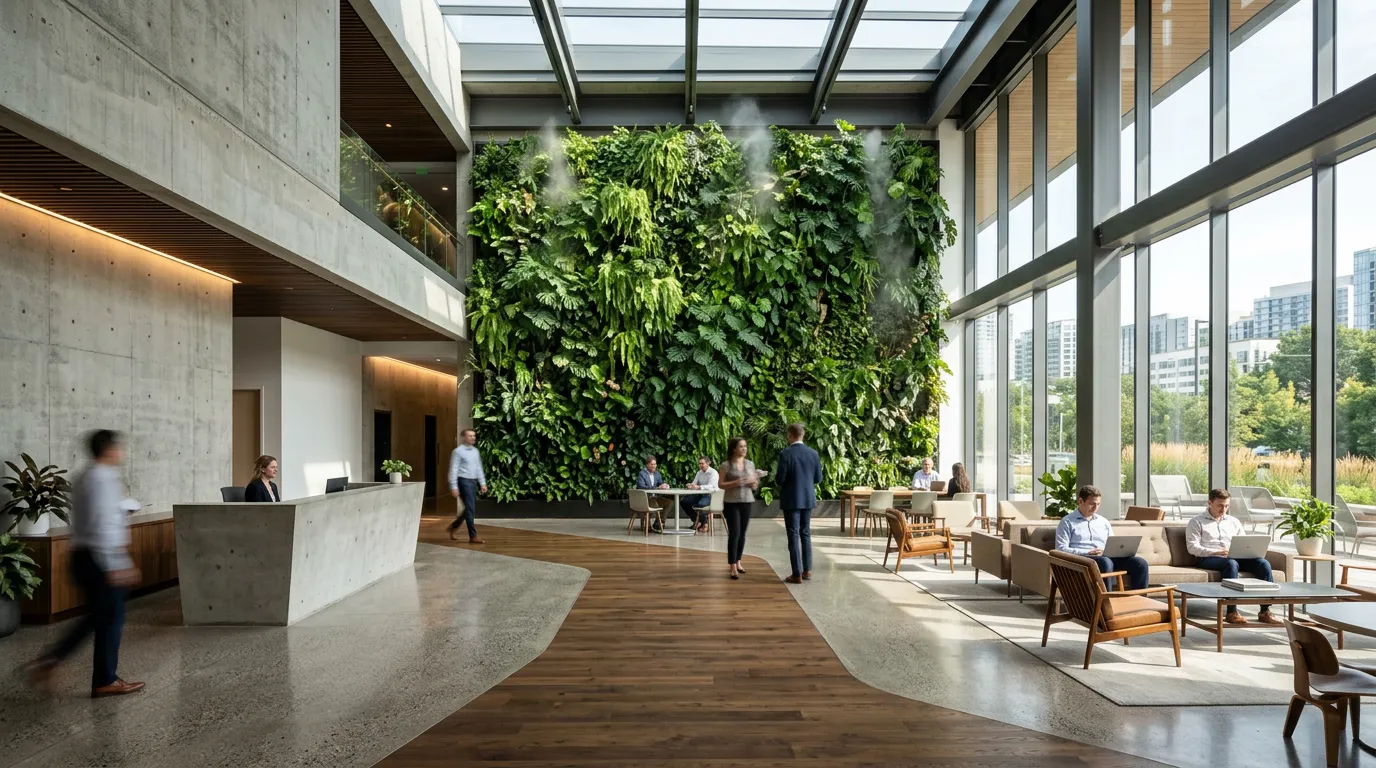
High work pressures within dense commercial zones demand spatial innovations that are not merely aesthetic, but capable of actively restoring mental well-being. For decades, corporate office architecture has been dominated by linear layouts, rigid partitions, and monotonous artificial lighting that completely isolates humans from the external ecosystem. This conventional design pattern is now identified as a primary catalyst for mental fatigue, diminished focus, and widespread burnout across corporate environments.
As a concrete answer to this exhaustion, Biophilic Office Design introduces a radical transformation. This approach no longer views the office as a static utility container, but rather as a living organism that must interact harmoniously with its occupants. Through the integration of green architecture, the workspace transitions into a healing oasis that restores psychological balance for employees amidst fast-paced business dynamics.
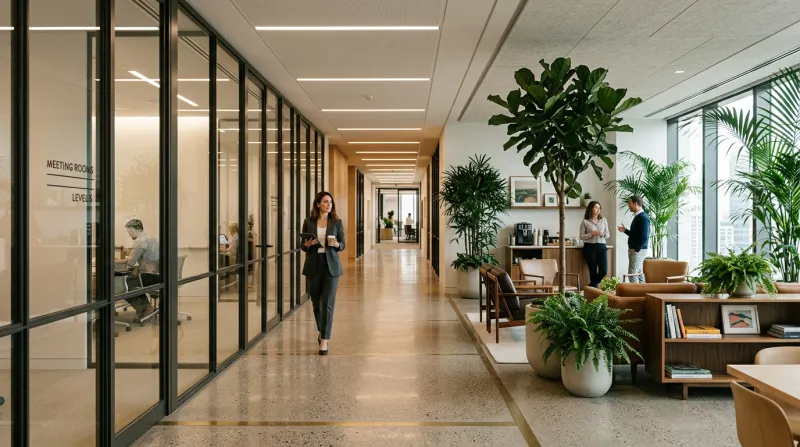
Photo source by SR Digital - Alinear Indonesia (Adobe FireFly – Gemini AI)
Sensory Integration and Circadian Synchronization
The foundational principle of biophilic design lies in fulfilling humanity's inherent need to connect with nature (biophilia). To execute this effectively on an enterprise scale, interior planning must incorporate authentic, living natural elements structurally, rather than simply scattering potted plants in empty corners.
An adaptive internal architecture seamlessly integrates three primary sensory pillars within the space:
•• Living Wall Ecosystems (Vertical Gardens): Utilizing authentic vertical vegetation to optimize air quality, absorb high-frequency acoustic clutter, and provide constant, eye-refreshing visual green stimuli.
•• Circulating Indoor Water Systems: Introducing water elements with acoustically engineered flowing sounds. This auditory stimulation acts as a natural mask for office white noise, lowering motor-nerve tension.
•• Full-Spectrum Circadian Lighting: Intelligent lighting systems engineered to mirror the shifting color temperature and intensity of outdoor sunlight. This synchronization supports the body's natural circadian rhythm, keeping employee cortisol and melatonin production balanced throughout working hours.
According to modern spatial data, consistent visual and auditory interactions with natural elements inside an office environment demonstrate a capacity to reduce employee cortisol levels by up to 15%. Implementing these features directly sharper cognitive performance, which is vital for macro-level decision-making across management.
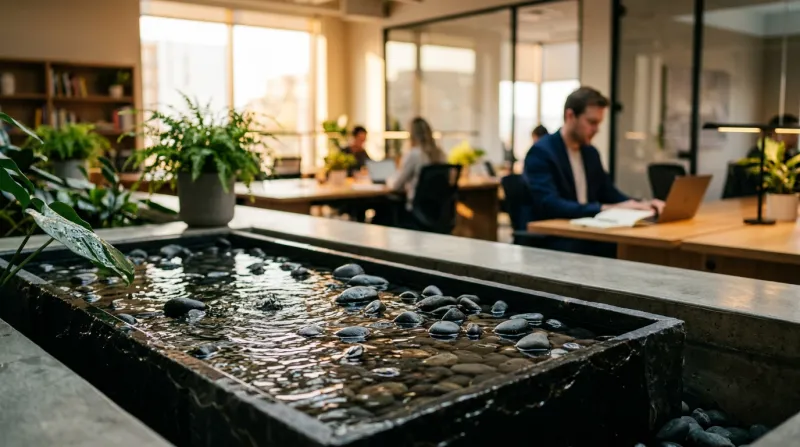
Photo source by SR Digital - Alinear Indonesia (Adobe FireFly – Gemini AI)
Strategic Alignment with Health-Centric Spatial Efficiency
Deploying biophilic design is far more than a luxury lifestyle trend; it is a tactical business strategy that coordinates directly with long-term spatial efficiency. This architectural methodology—prioritizing mental well-being and space optimization—serves as a core inspiration for compact vertical housing configurations explored in [Compact Living: Micro Apartments]. Whether designing an enterprise workspace or a micro-living unit, the core challenge remains identical: eliminating spatial restriction and density through clever visual engineering.
By shifting the corporate focus from sheer furniture volume to optimal air and light quality, an enterprise can engineer workspace footprints that are highly efficient yet inherently restorative. Every square meter is optimized to yield positive health outcomes, driving down stress-related absenteeism while ensuring the physical layout naturally supports peak productivity.
"Bringing nature into the workspace is no longer about decorative accents; it is a sophisticated strategy to humanize the corporate ecosystem."
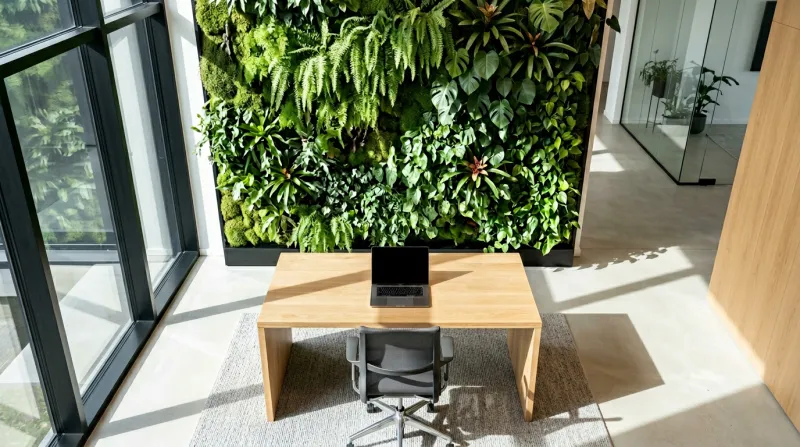
Photo source by SR Digital - Alinear Indonesia (Adobe FireFly – Gemini AI)
Building Spatial Narratives Through Unified Communication
A healthy, balanced internal work environment organically impacts an organization's performance and external representation. When employees operate within environments that actively renew cognitive clarity, the resulting creative execution, strategic choices, and market-facing narratives become substantially more solid, unified, and impactful.
•• Authentic Corporate Identity: A physical office environment built on sustainable design principles beams a powerful, authentic message regarding the enterprise's core values.
•• Corporate Message Synergy: Clear cognitive reasoning nurtured by a stress-free environment enables teams to draft authoritative corporate messaging devoid of informational dissonance.
•• Reflected Enterprise Wellness: Successfully establishing an internal operational oasis generates a positive market reputation, elevating organizational appeal to elite professional talent and premier business partners.

Photo source by SR Digital - Alinear Indonesia (Adobe FireFly – Gemini AI)
"Great architecture is never measured solely by its structural rigidity, but by how effectively it restores intellectual clarity to the human minds within it."
Spatial Design and Enterprise Ecosystem Sustainability
An institution's capacity to balance physical spaces with human psychological needs serves as a primary marker of progressive governance. Biophilic design is no longer a secondary aesthetic option; it is a critical infrastructure asset that dictates organizational resilience and corporate sustainability. When nature is precisely integrated with modern engineering, the workspace ceases to be a source of structural strain and instead becomes a self-renewing engine of corporate innovation.
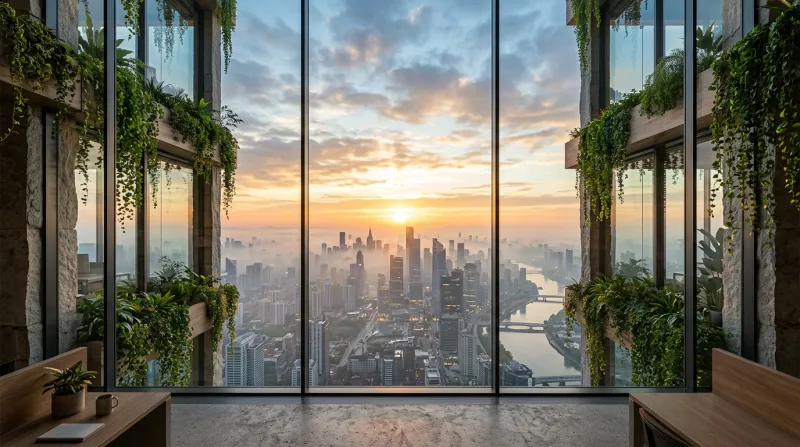
Photo source by SR Digital - Alinear Indonesia (Adobe FireFly – Gemini AI)
THE WRAP-UP!
Evolving a conventional office layout into a biophilic ecosystem is a high-return strategic investment to mitigate employee stress and accelerate cognitive agility. By integrating circadian lighting pathways, live vegetation architectures, and fluid acoustic elements, enterprises create workspaces that are healthy, highly efficient, and adaptive to modern economic demands.
Audit the existing lighting balances, air purification metrics, and visual frameworks inside your current workspace. Launching spatial updates through layout realignments and structured vertical green zones serves as the initial foundation to secure a productive, long-term corporate ecosystem.
Looking to feature your brand and business through Alinear Indonesia’s Smart Publication & Smart Activation? Share your experience and consult with us today. Click here!



![Alinear Indonesia [Brand/Business Registration] Smart Publication & Smart Activation](https://www.alinear.id/assets_web/images/qr-codes/3e23e7dab43d2e72854ba48a3a09cf75.jpg)