


Photo source by Alinear Indonesia Docs. (Adobe FireFly – Gemini AI)
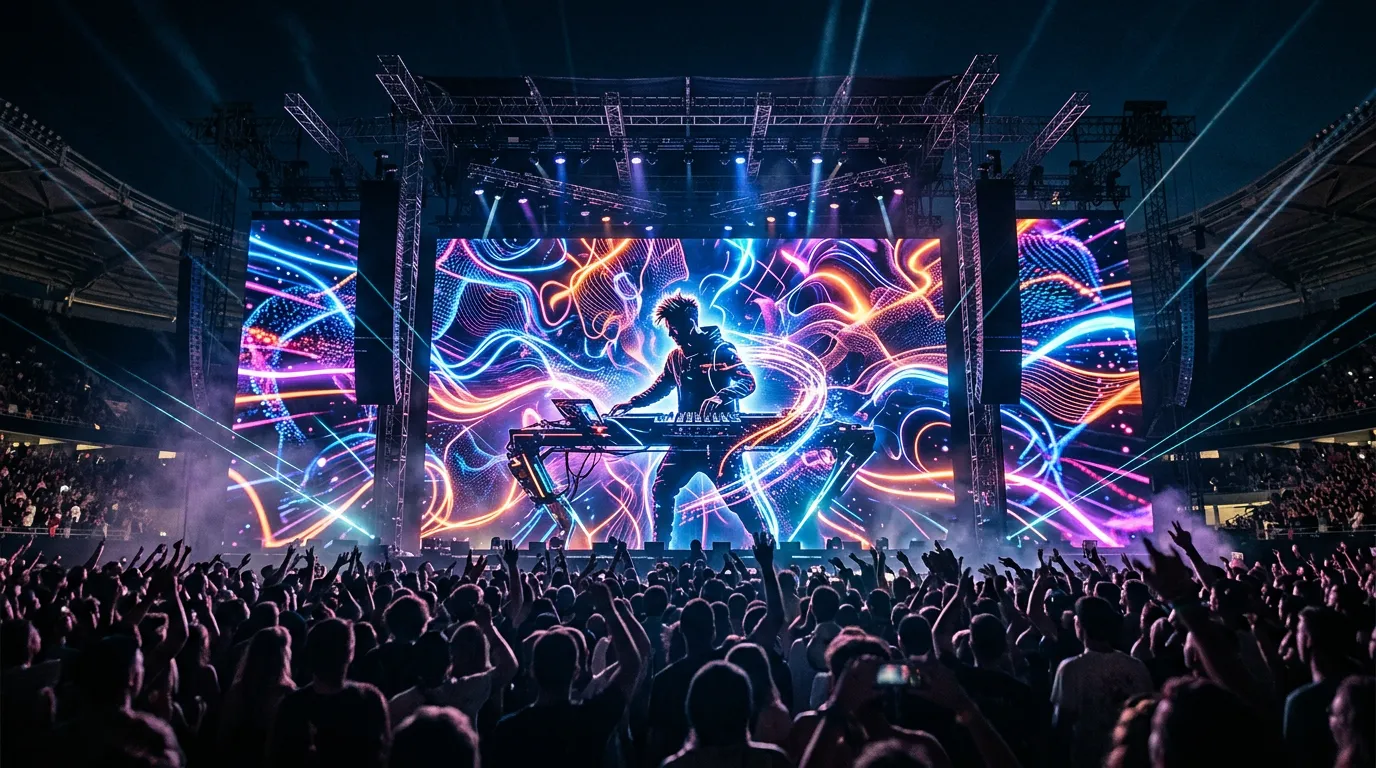
For years, the visual backdrops of major stadium music tours followed a rigid, predictable blueprint. Concert arenas relied entirely on pre-rendered video files synchronized to a fixed master clock or linear timecode track. While functionally stable, this framework confined the performance to a rigid structure; if an artist chose to jam spontaneously, extend a guitar solo, or alter the tempo to mirror the crowd’s energy, the background video would awkwardly continue its mismatched loop. The stage visual remained a flat, passive wallpaper completely detached from the organic fluctuations of live music.
This technical boundary has collapsed. The modern entertainment landscape is aggressively pivoting toward intelligent computational canvas architectures. By implementing real-time generative graphic logic, stage designers are abandoning passive video rollbacks in favor of reactive digital ecosystems that breathe, warp, and evolve in perfect alignment with the sonic current: Smart Activation.
Decoupling the Waveform: Fast Fourier Transform (FFT) and Pixel Mutation
At the heart of the generative live-visual infrastructure sits a real-time data processing pipeline that translates sound waves into visual coordinates. Instead of relying on manual cue-triggering, modern media setups feed direct audio signals from the mixing console into specialized interactive software engines. These systems utilize Fast Fourier Transform (FFT) algorithms to break down complex live audio feeds into distinct mathematical variables.
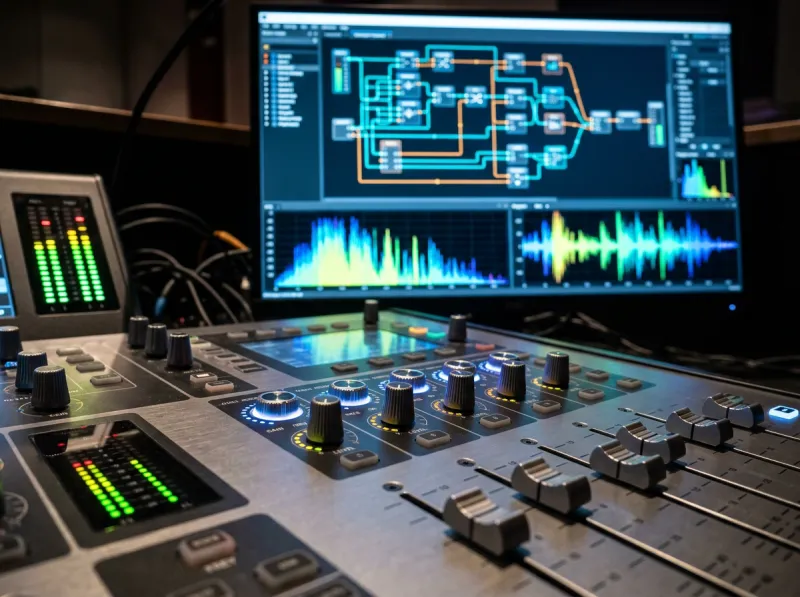
Photo source by Alinear Indonesia Docs. (Adobe FireFly – Gemini AI)
The FFT pipeline continuously quantifies sound into clean data metrics: low-end sub-bass frequencies dictate the spatial scale of 3D geometric meshes, mid-range vocal velocities control particle dispersion vectors, and sharp high-hat transiency triggers sudden chromatic shifts. This data-to-pixel routing executes with ultra-low latency, ensuring that when a drummer hits a snare, the stadium's massive LED canvas erupts visually within fractions of a millisecond, establishing pristine sensory alignment without carbon-copy repetition.
The Real-Time Pipeline: Unreal Engine, TouchDesigner, and AI Prompt Injection
The modern stage technical footprint relies heavily on advanced real-time rendering software networks. Tools like Derivative TouchDesigner, Notch, and Unreal Engine 5 operate as the foundational node-based infrastructure, allowing creative engineers to build complex interactive rulebooks. These engines ingest incoming MIDI signals, tracking data from artist wearables, and audio feeds to compute millions of graphic particles on the fly.
Furthermore, the integration of generative AI has added a layer of fluid unpredictability to stage design. Rather than relying on simple geometric shapes, contemporary tours incorporate low-latency neural network layers directly into the rendering chain. This allows real-time audio feeds to act as continuous structural modifiers on AI-generated dreamscapes. The visual output is generated live, sound wave by sound wave, ensuring that the visual art displayed on stadium displays during a Monday night show in Jakarta will never look identical to the performance delivered on a Friday night in Tokyo.
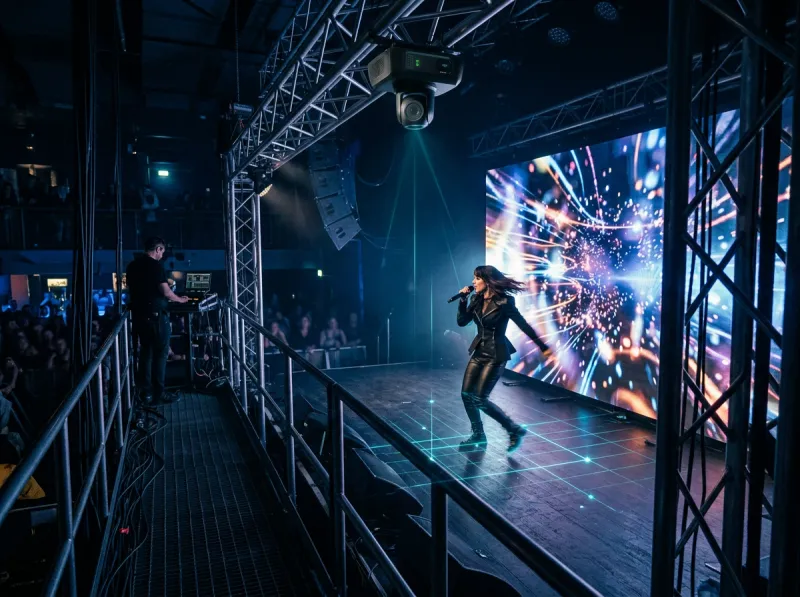
Photo source by Alinear Indonesia Docs. (Adobe FireFly – Gemini AI)
Spatial Kinematics and the Immersive Audience Feedback Loop
The application of generative visual computing has fundamentally re-engineered the physical dynamics of stadium spatial layout. By pairing generative algorithms with real-time infrared tracking camera systems (such as LiDAR or BlackTrax), the stage canvas becomes aware of the artist’s precise physical location.
As the performer moves across the stage catwalk, the interactive graphics on the LED screens warp around their silhouette, casting digital shadows, or spawning trails of responsive particle systems that chase their movements. This interactive environment extends directly to the audience; camera feeds monitoring the crowd's movement density can be translated into data points that alter the speed and atmospheric color palette of the generative artwork. This creates a multi-directional sensory feedback loop where the musician, the visual asset, and the crowd constantly influence one another in real time.
"The modern concert stage has graduated from a passive projection wall to an active digital intelligence that listens to the music and paints its own reality in real time."
The Future of Scenography: Code as the New Creative Currency
As live entertainment pushes further into hyper-immersive territories, the role of the traditional video editor is evolving into that of a digital architect and software engineer. Future concert sets are no longer designed using static style frames; they are coded as dynamic, rule-based systems capable of infinite visual mutations.
Through this union of algorithmic precision and musical performance, generative stage art shows that technology does not dilute the human element of live performance—it amplifies it. By transforming volatile acoustic energy into spectacular, living visual expressions, generative graphics elevate stadium concerts into true monuments of interactive digital culture, building highly responsive, unrepeatable spectacles that redefine how audiences experience live sound.
Photo source by Alinear Indonesia Docs. (Adobe FireFly – Gemini AI)
"In an era of total digital duplication, generative live-visuals restore absolute exclusivity to the concert experience: what you see and hear tonight exists only in this exact moment, never to be replicated again."
WRAP-UP!
The ascension of generative live-visuals signals a major paradigm shift across the global entertainment landscape. By harnessing low-latency audio-reactive processing and real-time algorithmic rendering, production teams convert stadium backdrops into fluid, unrepeatable digital art ecosystems. This technical evolution eliminates the predictability of pre-rendered show files, allowing live visuals to move in perfect harmony with human musical expression. As creative code continues to merge with physical stage scenography, the live music arena cements its position as the ultimate venue for interactive digital art exploration.
Analyze your current entertainment production layouts and venue media infrastructure; explore opportunities to replace conventional linear video servers with node-based procedural engines, assess real-time FFT audio integration into your brand activations, and deliver an interactive, unrepeatable sensory journey for contemporary tech-forward audiences.
Looking to feature your brand and business through Alinear Indonesia’s Smart Publication & Smart Activation? Share your experience and consult with us today. Click here!



![Alinear Indonesia [Brand/Business Registration] Smart Publication & Smart Activation](https://www.alinear.id/assets_web/images/qr-codes/3e23e7dab43d2e72854ba48a3a09cf75.jpg)