


Photo source by Alinear Indonesia Docs. (Adobe FireFly – Gemini AI)
For decades, visiting an art gallery followed a strict, unwritten code of conduct: stand at a polite distance, keep your hands to yourself, and observe in silent reverence. The art was static, frozen in time by the artist's final brushstroke or a pre-rendered video loop playing on an endless projector cycle. But in the neon-soaked galleries of modern Jakarta, that code is being systemically rewritten.
Enter Generative Spatial Scenography—a technological leap where code, space, and human biology merge. Guided by the ethos of Wired and Mashable tech-culture, local creative collectives and digital artists are turning galleries into living ecosystems. In these spaces, you are no longer just looking at art. Your physical presence, your heat signatures, and your erratic footsteps serve as the primary source code, dictating how the installation breathes, pulses, and glows.
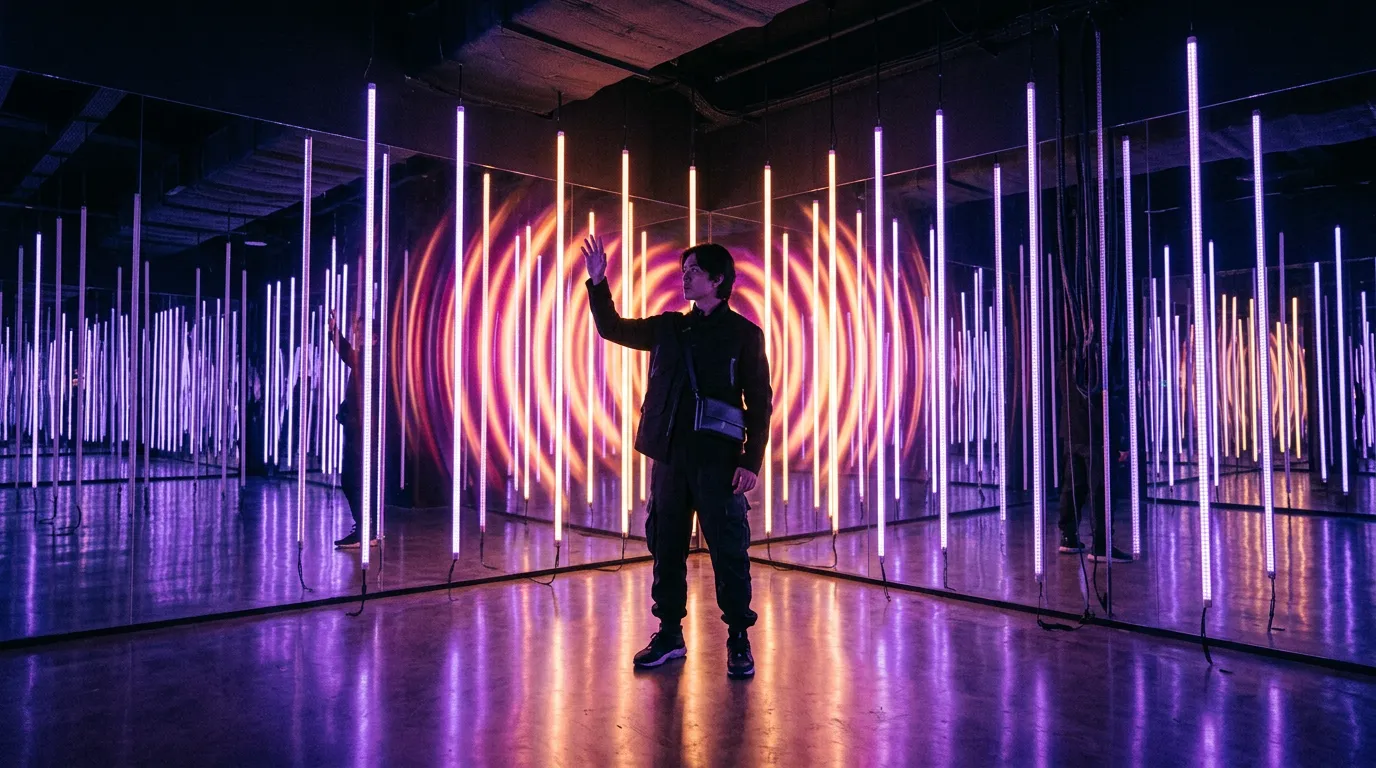
Responsive Light Chamber
To understand how these rooms "think," one must look behind the drywall and mirror arrays to view the physical computing stack. The system functions as a continuous feedback loop between human input and procedural code.
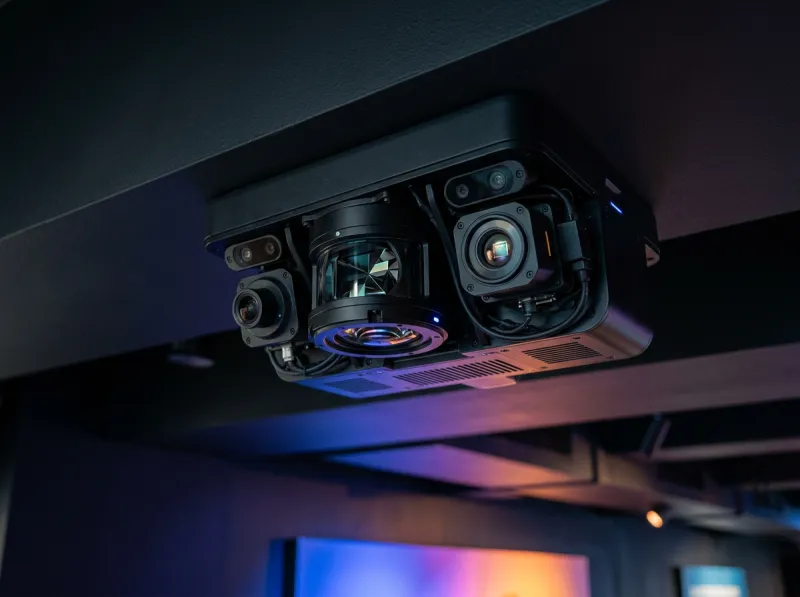
Photo source by Alinear Indonesia Docs. (Adobe FireFly – Gemini AI)
When a visitor steps into the gallery, they are immediately scanned by ceiling-mounted LiDAR arrays and infrared sensors. Unlike conventional cameras, these sensors ignore visual details, capturing only coordinate vectors (X, Y, Z) and thermal output (body heat).
This data is fed instantaneously into a processing engine—frequently built on TouchDesigner or Unreal Engine. The generative script processes the raw physical values and translates them into DMX/Art-Net control commands. These commands dictate the behavior of thousands of addressable LED tubes suspended throughout the space, reflecting off meticulously angled, infinite mirror walls.
The Interactive Choreography: From Coordinates to Chromatic Waves
How does code translate human behavior into visual poetry? It relies on mapping mathematical variables to physical properties.
•• Velocity as Pulse Rate: If a visitor walks slowly, the LED tubes around them glow with a languid, rhythmic fade. Run or move erratically, and the pulse speed spikes, creating sharp staccato flashes that ripple across the room.
•• Body Heat as Color Temperature: Thermal sensors map the warmth of a crowd. A solitary visitor might trigger deep, cool blues and violet hues. As more people gather, the localized temperature values climb, causing the algorithm to gradually bloom into intense crimson, amber, and gold.
•• Proximity as Spatial Scale: As you approach a wall of mirrors, the light waves shrink and intensify around your silhouette, wrapping you in a customized halo of generative light. Step back, and the light dissolves back into the general ambient flow of the room.
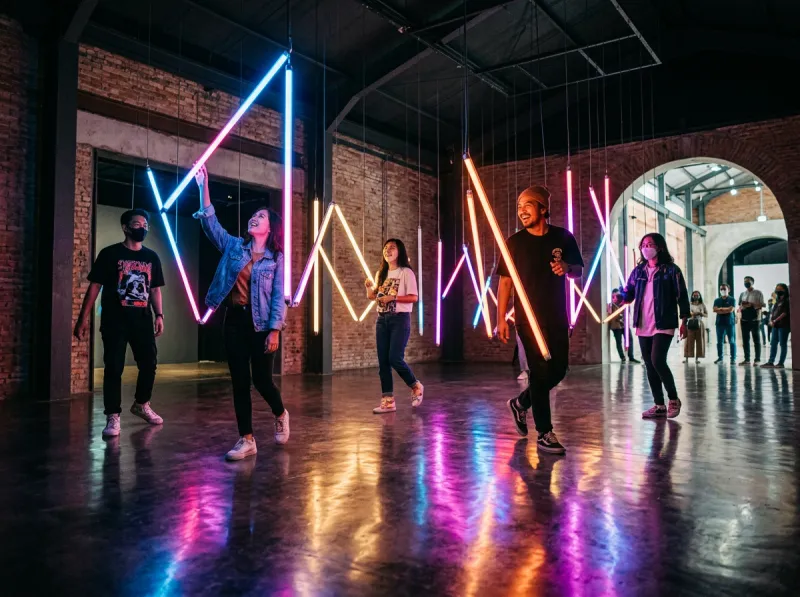
Photo source by Alinear Indonesia Docs. (Adobe FireFly – Gemini AI)
New Immersive Spaces: A Digital Renaissance
This aesthetic revolution is not happening in a vacuum; it is taking over creative hubs from Kebon Jeruk to the heart of the SCBD. Galleries and temporary pop-ups are transforming raw industrial spaces into high-concept digital sanctuaries. Local digital artists are using these installations to explore themes of urban isolation, digital connectivity, and the fragile relationship between humans and technology.
"In the generative gallery, you are no longer a consumer of the exhibit; you are its heartbeat, its speed, and its primary color."
By deploying Smart Activation principles, curators are creating spaces that are highly shareable yet deeply personal. No two visits to these installations are identical. Because the visual patterns are generated on-the-fly based on real-time crowd dynamics, every photograph, every video, and every personal experience is entirely unique—a perfect convergence of fleeting analog moments and persistent digital systems.
The Future of Spatial Art: Designing for the Post-Screen Era
As screens continue to saturate every corner of our daily lives, our tolerance for flat, two-dimensional media is hitting a limit. Generative spatial scenography represents the transition into the post-screen era, where entire rooms become the interface.

Photo source by Alinear Indonesia Docs. (Adobe FireFly – Gemini AI)
For designers, architects, and brands, this is a radical playground. The ability to make physical materials respond to human presence opens up new ways of storytelling. In the future, office lobbies, retail flagships, and public squares will not just be built; they will be programmed to recognize, react, and converse with the people who inhabit them, proving that the spaces we build are just as alive as we are.
"Interactive art has moved past the button-pressing phase. Today, simply existing in a room is enough to make the architecture dance."
WRAP-UP!
Generative spatial scenography is turning light art into a collaborative dance between human bio-data and complex software systems. By utilizing real-time infrared tracking and procedural generation, Jakarta's galleries are shifting the role of the viewer from passive observer to active co-creator. These responsive environments show us a glimpse of a future where tech doesn't isolate us behind small glass screens, but expands outward to make our physical reality infinitely more magical.
To fully appreciate this digital shift, look out for local experiential design showcases in Jakarta's cultural hubs, focus on how your movement alters the light gradients around you, analyze the physical placement of the tracking hardware, and embrace the truth that your presence is completing the artist's canvas in real-time.
Looking to feature your brand and business through Alinear Indonesia’s Smart Publication & Smart Activation? Share your experience and consult with us today. Click here!



![Alinear Indonesia [Brand/Business Registration] Smart Publication & Smart Activation](https://www.alinear.id/assets_web/images/qr-codes/3e23e7dab43d2e72854ba48a3a09cf75.jpg)