


Photo source by Alinear Indonesia Docs. (Adobe FireFly – Gemini AI)
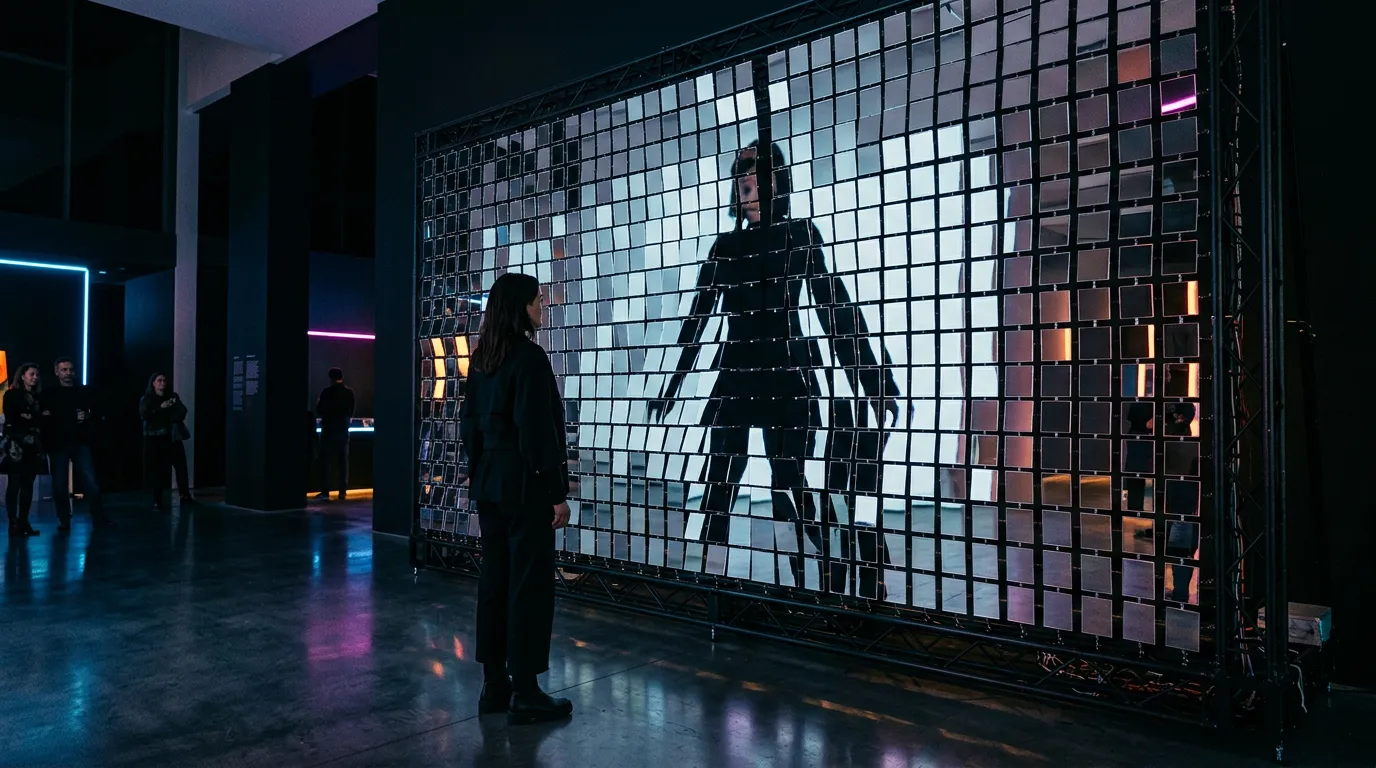
In the contemporary landscape of entertainment and visual arts, the traditional borders separating the artwork from its audience have completely collapsed. Adopting the progressive viewpoint of Wired Culture, art is no longer viewed as a static object hanging passively on a white gallery wall. Instead, modern art has evolved into an active, living, responsive system that requires the physical presence of a human being to achieve its full visual realization.
The most spellbinding manifestation of this shift is the sudden rise of the interactive kinetic mirror installation. Fusing structural design, robotic engineering, and creative computational code, this new media medium delivers an immersive experience that challenges a subject's perception of identity and space, turning a basic reflection into an engineered mechanical symphony.
From a technical standpoint, a kinetic mirror array is a tangible combination of hardware precision and software fluidity. Rather than employing a single, uniform reflective sheet, these installations are constructed from hundreds or thousands of miniature, independent mirror segments arranged in a clean geometric matrix.
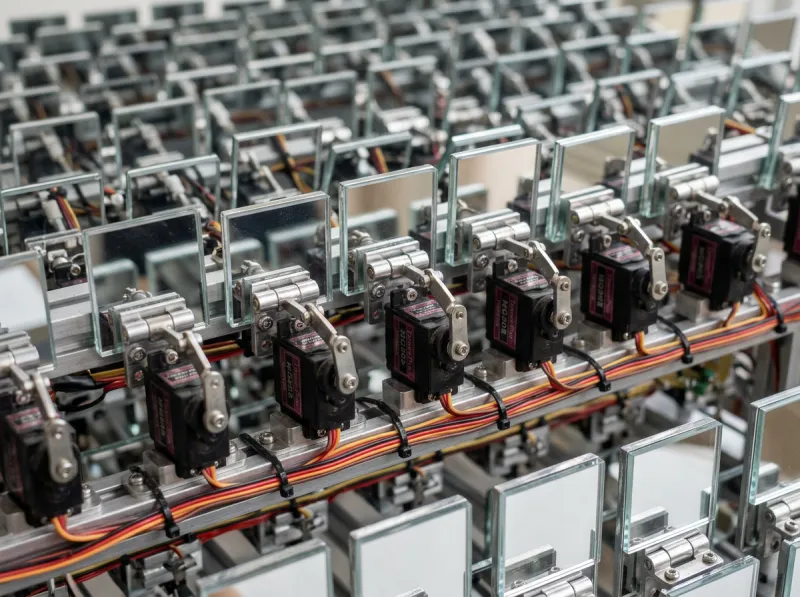
Photo source by Alinear Indonesia Docs. (Adobe FireFly – Gemini AI)
Each small mirror panel is mounted to an independent smart micro servo motor. When the space is completely vacant, the array rests as a flawless, flat mirror plain. However, the moment the network registers activity, individual motors push forward, pull back, or tilt at precise angles, creating a physical fluid wave that absorbs and scatters surrounding light.
The secret behind this interactive magic rests inside a highly advanced computer vision tracking framework. Discrete depth-sensing cameras are hidden around the layout, continuously scanning the spatial volume directly in front of the mirrored surface.
When a viewer steps into the interaction zone, the depth sensor instantly captures the x, y, and z coordinates of their silhouette. This spatial data is processed by custom software algorithms within milliseconds, translating human motion into physical commands dispatched directly to the servo array. The resulting real-time synchronization causes thousands of mirrors to ripple in perfect unison, mimicking the curves and speed of the human form standing before it.
The Aesthetic of Fragments and the Dissolution of Ego
Aligning with the sharp visual critique of Mashable Culture, the psychological impact of the kinetic mirror is far more compelling than its raw mechanical specs. As the mirror wall moves in direct response to your gestures, your physical reflection ceases to be a predictable whole, shattered instead into hundreds of dynamic visual fragments.
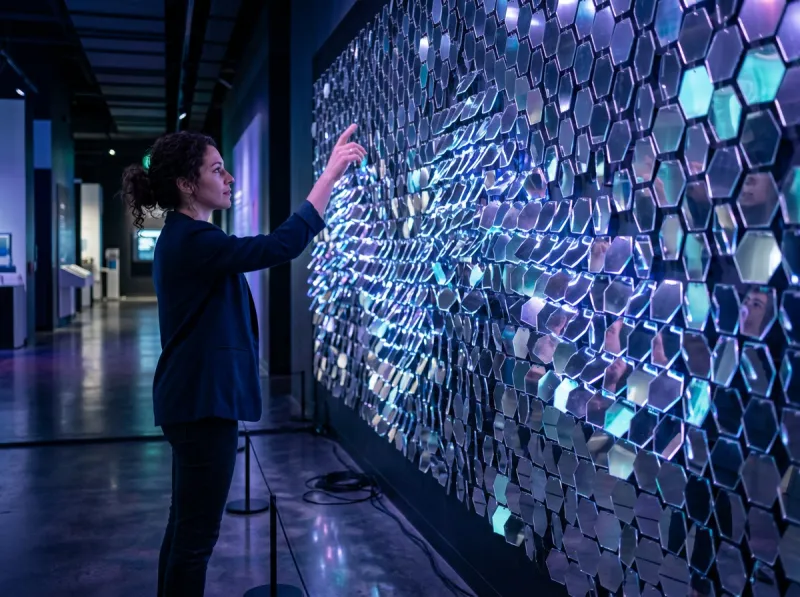
Photo source by Alinear Indonesia Docs. (Adobe FireFly – Gemini AI)
"Kinetic art transforms technology from a cold, rigid computing tool into an emotional mirror that breathes in perfect rhythm with our movements."
When you raise an arm, a physical wave ripple tears the silhouette apart, weaving it back together into a flowing, organic abstract pattern. This visual distortion shatters the conventional view of a mirror as an honest reflective tool. Instead, the wall operates as a living artistic collaborator, forcing viewers to see themselves integrated entirely as the primary graphic element of the piece.
Looking toward future developments, this seamless marriage of visual artistry and mechanical computing will redefine how experiential entertainment spaces are built. Interactive kinetic mirrors are expanding far beyond traditional contemporary galleries, establishing a permanent presence as dynamic architectural walls in progressive urban hubs, corporate lobbies, and interactive public forums.
This movement proves that advanced technology does not have to render human interaction cold and mechanical. Through thoughtful code design and precise physical calibration, technology can unlock a deeply personal, magical aesthetic experience, reuniting human beings with their own image in a manner never before imagined.
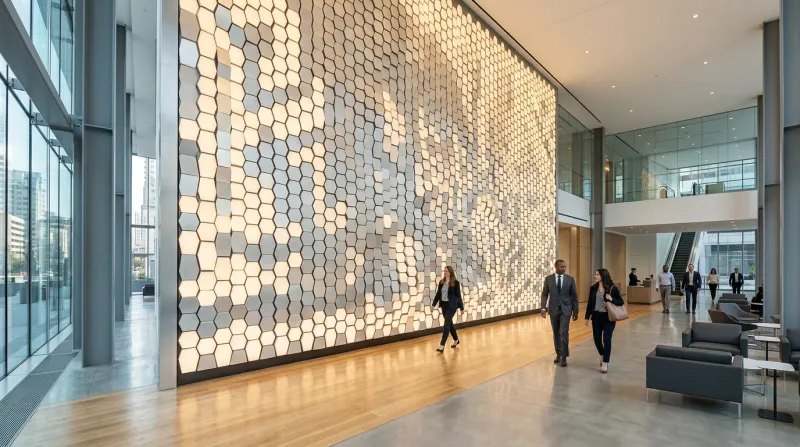
Photo source by Alinear Indonesia Docs. (Adobe FireFly – Gemini AI)
"When the boundary between the observer and the artwork collapses entirely, you are no longer just looking at art—you are the art."
WRAP-UP!
The rise of interactive kinetic mirror installations highlights an exciting new era in visual entertainment that prioritizes real-time interactivity and flawless robotic execution. By linking depth tracking, custom motion algorithms, and thousands of motorized panels, this medium creates a new artistic frontier where human motion and mechanical systems seamlessly collaborate.
To design a highly successful kinetic installation, engineering teams must calibrate sensor-to-servo latency below the threshold of human perception, utilize lightweight, high-grade reflective composite panels to minimize motor stress, and develop a varied matrix of algorithmic behaviors to ensure public interactions remain consistently engaging and fresh.
Looking to feature your brand and business through Alinear Indonesia’s Smart Publication & Smart Activation? Share your experience and consult with us today. Click here!



![Alinear Indonesia [Brand/Business Registration] Smart Publication & Smart Activation](https://www.alinear.id/assets_web/images/qr-codes/3e23e7dab43d2e72854ba48a3a09cf75.jpg)