


Photo source by Alinear Indonesia Docs. (Adobe Firefly – Gemini AI)
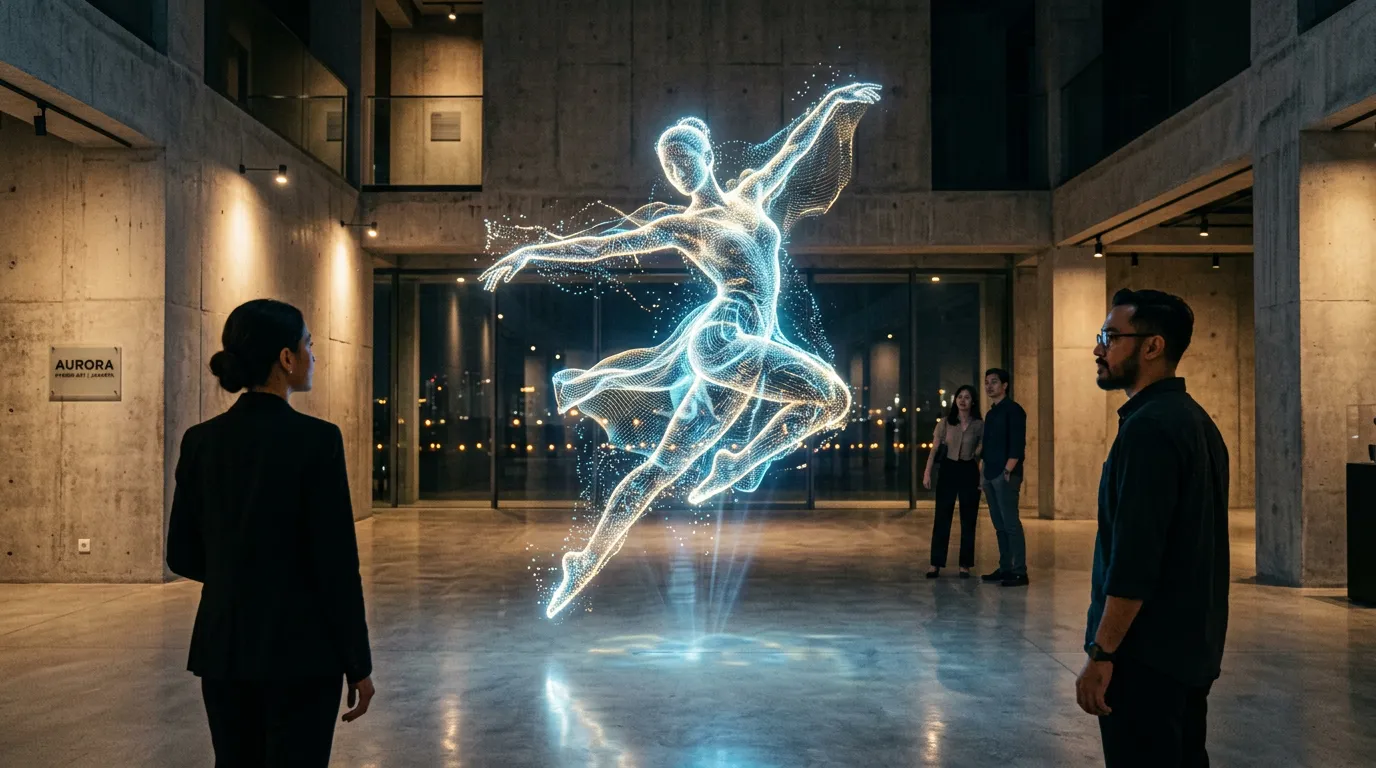
For the past decade, "digital art" in urban exhibition spaces has often remained confined by the limits of flat displays or the optical illusions of industrial projectors. Audiences have been conditioned to stand in the center of a room while two-dimensional moving images are beamed across surrounding walls. While visually stunning, this format suffers from a rigid structural limitation: the audience remains a passive observer separated by a flat surface. The pixels never truly step off the wall to breathe in the same room as the viewer.
Today, Jakarta's most progressive new media art spaces are piloting a technology that shatters this boundary entirely. Through Volumetric Video Art, digital expression liberates itself from the constraints of 2D planes and claims its own spatial sovereignty. It is no longer about looking at art rendered on a surface; it is about sharing physical coordinates with a digital entity: Smart Activation.
Unlike conventional filmmaking, which relies on single lenses to fake a depth of field, volumetric video is a high-level computational visual process. Inside a specialized capture stage, the subject—such as a contemporary dancer—is encircled by an array of 32 to 64 ultra-high-resolution cameras, all hooked up to a centralized computing system running on microsecond-level synchronization.
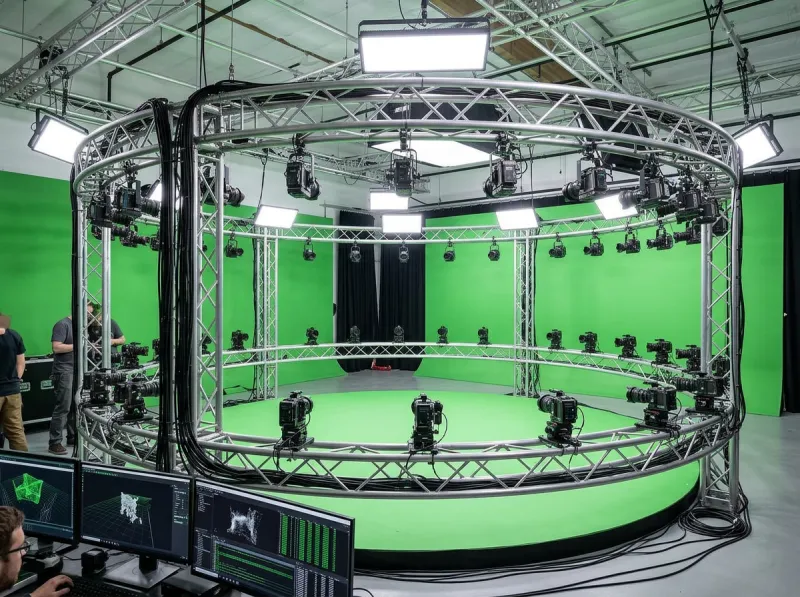
Photo source by Alinear Indonesia Docs. (Adobe Firefly – Gemini AI)
Instead of a flat video file, this matrix captures the exact volume of the object in real time. The computers process billions of geometric data coordinates per second—known as point-cloud data—and wrap them in life-like visual textures. The resulting product is a massive three-dimensional digital asset that has no hidden "backside"; every fold of moving fabric, bead of sweat, and micro-facial expression is preserved from every angle allowed by physics.
When these volumetric video assets are rendered in an exhibition space using modern holographic displays or integrated spatial sensor grids, the visitor's relationship to the art undergoes a complete transformation. The digital art piece floats freely in the middle of the room, occupying space as if it possessed physical weight.
As a visitor steps forward, circles to the right, or ducks to examine the lower half of the projected digital dancer, their visual perspective updates with perfect accuracy—exactly as it would if they were looking at a living human being. In this ecosystem, the audience is no longer restricted by a director’s or photographer's chosen lens angle; the viewer themselves becomes the moving camera. This navigational freedom builds an emotional connection and sensory engagement rate previously unachievable by any traditional visual medium.
The adoption of this tech by Jakarta's contemporary curators and artists marks a new era for experiential entertainment. Early implementations demonstrate that volumetric video is exceptionally powerful when used to archive and recontextualize dynamic cultural elements—such as the precise, sharp movements of a traditional Topeng dance or the high-intensity drama of Pencak Silat—and present them within a hyper-futuristic digital aesthetic.
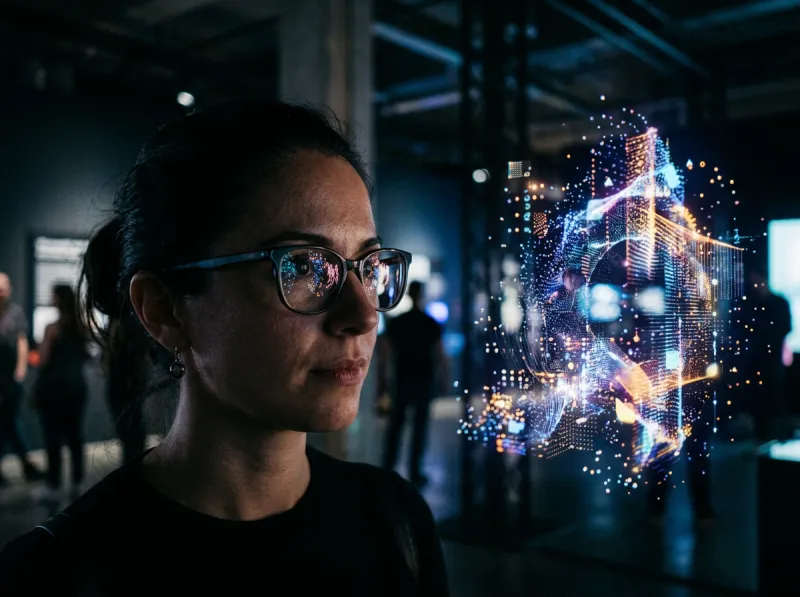
Photo source by Alinear Indonesia Docs. (Adobe Firefly – Gemini AI)
"Volumetric video technology isn't trying to duplicate reality onto a screen; it is forcing digital pixels to step down and breathe alongside us in physical space."
For commercial galleries and experimental retail environments, this technology acts as a robust tool for Smart Activation. Exhibitions no longer require complex logistics to ship heavy, fragile physical sculptures across international borders. Artworks from global creators can be transferred as pure encrypted digital code and reconstructed inside a Jakarta gallery space with millimeter-level precision.
Volumetric Video Art serves as definitive proof that the future of visual media is untethering itself from the hardware we hold in our hands or the screens we mount on our walls. We are moving rapidly toward an era of spatial computing, where digital data merges organically with our immediate physical environments.
For media creators and owners of contemporary entertainment spaces, investing in an understanding of volumetric capture pipelines is no longer about chasing a seasonal tech trend. It is a calculated business move to secure a position at the frontlines of the creative economy, where the line between real and virtual is no longer a barrier, but a brand-new canvas ready to be explored.
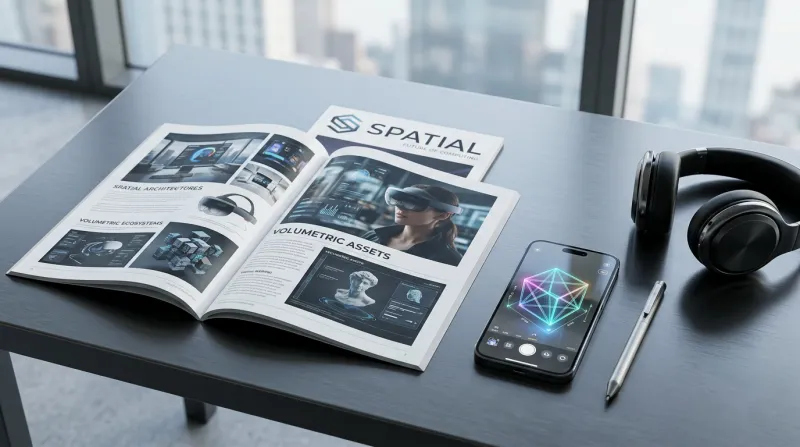
Photo source by Alinear Indonesia Docs. (Adobe Firefly – Gemini AI)
"In the age of spatial computing, art curators no longer arrange pictures on a wall—they orchestrate a living presence within a room."
WRAP-UP!
The arrival of Volumetric Video Art completely redefines the boundaries of creativity within new media art and digital entertainment industries. By delivering true three-dimensional captures that are entirely free from screen barriers, it offers a raw, interactive sensory experience tailored to modern audiences. This phenomenon proves that future art space activation strategies must rely on creating a spatial dialogue between digital creations and the physical presence of humans.
Evaluate your commercial retail, gallery, or entertainment spaces for integration with spatial computing infrastructure; begin upskilling creative teams to process 3D mesh assets and point-cloud data, and design experiential exhibition concepts that prioritize physical visitor exploration to generate distinct commercial value and high organic social media virality.
Looking to feature your brand and business through Alinear Indonesia’s Smart Publication & Smart Activation? Share your experience and consult with us today. Click here!



![Alinear Indonesia [Brand/Business Registration] Smart Publication & Smart Activation](https://www.alinear.id/assets_web/images/qr-codes/3e23e7dab43d2e72854ba48a3a09cf75.jpg)