

Photo by Hatiful Yosa on Unsplash
The contemporary gaming industry has reached a threshold where the boundary between reality and digital simulation is practically non-existent. High resolutions, real-time ray tracing, and incredibly complex three-dimensional assets have become the baseline standard for large-scale commercial titles. Yet, beneath this awe-inspiring technological achievement, a subtle exhaustion has spread across the global player base. All too often, breathtaking visual grandeur masks a lack of foundational gameplay innovation, yielding experiences that feel formulaic, repetitive, and emotionally sterile.
Amid a landscape dominated by industrial realism, a compelling visual paradox is taking place. Modern games that deliberately utilize 8-bit and 16-bit pixel art aesthetics are experiencing a massive surge in popularity. This phenomenon proves that a game's true immersive power is no longer measured by the raw quantity of pixels rendered on a screen, but rather by how those visual limitations are masterfully managed to build a distinct identity, an evocative atmosphere, and an authentic emotional attachment with the player.
Pixel Art: The Art of Deliberate Constraint
Modern pixel art is not a lazy replication of past technological limitations. It is a highly precise artistic discipline where every single block of color on the display functions as a vital structural element. The core pillars anchoring this aesthetic philosophy include:

Photo by Element5 Digital on Unsplash
•• Intentional Minimalism: Stripping away visual noise down to the absolute essential forms. Modern pixel artists must convey complex character emotions, kinetic weight, and environmental moods through highly constrained geometric combinations.
•• Curated Color Palettes: Unlike the millions of color fields rendered in mainstream titles, pixel art relies on highly restricted, high-contrast color scripts. This approach fosters a visual delivery that is consistent, punchy, and instantly recognizable.
•• Frame-by-Frame Animation: Every character action is illustrated manually, sequence by sequence. This artisan technique yields animations that feel tactile, deliberate, and possess a rhythmic cadence unmatched by fluid 3D digital interpolation.
The Player's Imaginative Space: Filling the Visual Gaps
When a player encounters an ultra-realistic character model, the brain receives absolute visual information; there is zero room for interpretation. Conversely, 8-bit or 16-bit presentation operates on an entirely different cognitive frequency. A character comprised of stylized pixel blocks functions as an abstract symbol rather than a definitive portrait.
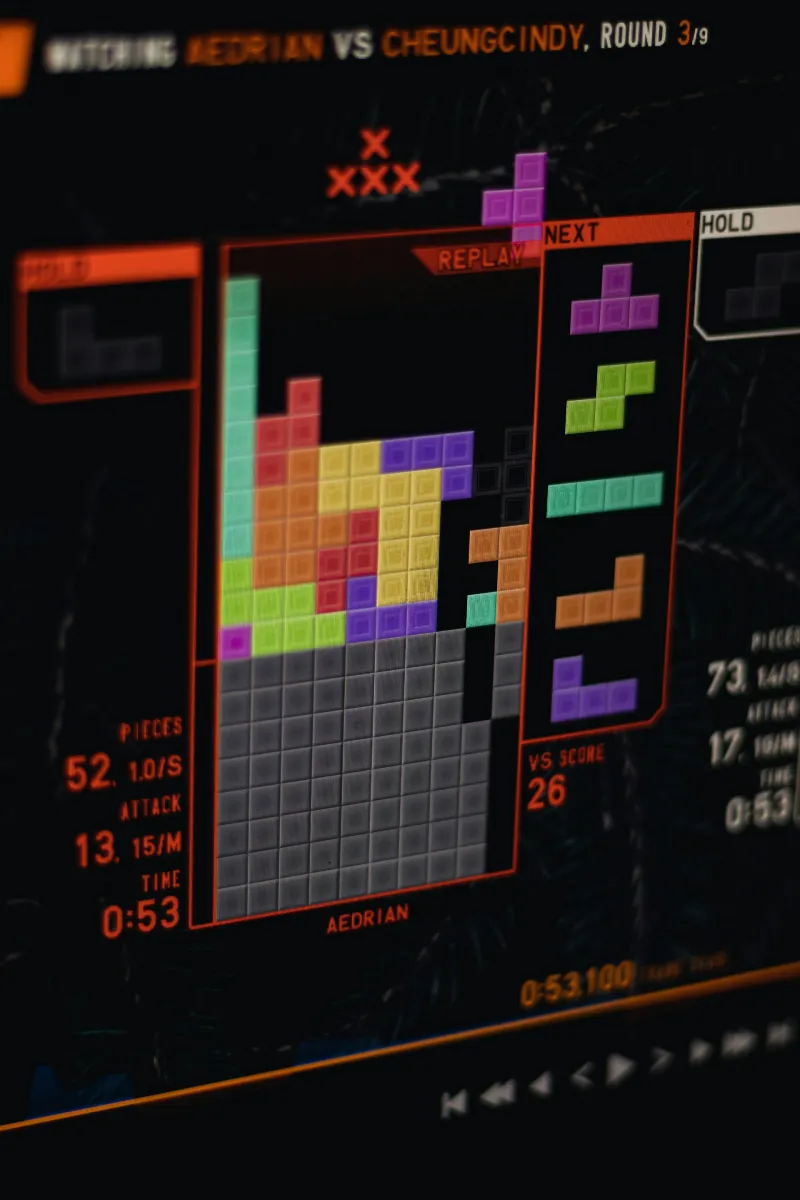
Photo by Aedrian Salazar on Unsplash
This visual restriction actively triggers the player's cognitive faculties, prompting the brain to fill in the missing details using personal imagination. This mental projection creates a layer of emotional investment that is deeply intimate and highly personal. The player is no longer merely observing a world entirely constructed for them; they are actively co-authoring its fine details within their own minds. This represents an elite form of interactivity, where graphic simplicity unlocks profound narrative depth.
Mechanical Priority: Restoring the Purity of the Gameplay Loop
For game developers, choosing the path of pixel art offers an immense strategic advantage regarding resource allocation. Engineering large-scale 3D visual environments absorbs massive amounts of capital and development time. By stepping away from the arms race of graphical realism, independent studios can focus their collective energy on the most fundamental element of interactive media: the gameplay mechanics.
This operational shift serves as the cornerstone for small-scale creative endeavors that champion storytelling and deep interactive variables [Micro-Indie Games: Kebangkitan Gim Narasi]. Free from the crushing burden of mainstream visual benchmarks, these titles are uniquely positioned to deliver razor-sharp controls, ingenious level design, and courageous, emotionally resonant storylines. The pixel grid acts as an efficient conduit, delivering the player directly to a pure, unadulterated, and addictive interactive core.
"Ultra-realistic graphics pamper your eyes, but the clean minimalism of pixel art challenges and liberates your imagination."
Retro Warmth Wrapped in Modern Engineering
The allure of pixel art is deeply tied to nostalgia, yet the contemporary movement extends far beyond a simple yearning for the past. For veteran gamers, these visuals evoke comforting childhood memories. For younger generations, pixel art offers a distinct alternative aesthetic—sharp, vibrant, and refreshingly unique against the uniform look of modern commercial titles.
Photo by Ethan Hasenfratz on Unsplash
Furthermore, modern pixel games seamlessly integrate contemporary engineering conveniences—such as dynamic lighting engines, widescreen resolutions, and flawless performance parameters—without compromising their classic souls. The resulting products feel both inherently familiar and intensely innovative, illustrating that visual trends in popular culture do not always move in a straight line; rather, they loop back to reclaim the timeless elements that hold enduring artistic value.
"When a game is unburdened by the relentless mandate to look real, it gains absolute freedom to focus on its true purpose: being brilliant, engaging, and meaningful."
WRAP-UP!
The widespread acclaim of Pixel Art Aesthetics in contemporary gaming demonstrates that the value of an interactive work is never dictated by the complexity of its graphic engine. By transforming visual constraints into an imaginative asset, prioritizing rigid mechanical execution, and delivering an authentic atmospheric tone, this classic medium has solidified its rank as an eternal art form in the modern entertainment sector.
For your next gaming session, bypass the massive, hardware-heavy blockbuster titles and immerse yourself in a narrative-driven pixel masterpiece to experience the raw purity of interactive design.
Looking to feature your brand and business through Alinear Indonesia’s Smart Publication & Smart Activation? Share your experience and consult with us today. Click here!